
For nearly a decade, international discussions about Arakan State have been dominated by a familiar narrative: persecution, displacement, refugee camps in Bangladesh, and the unresolved challenge of repatriation. These issues remain central to understanding one of Myanmar’s most complex humanitarian and political crises.
Yet Arakan is now experiencing a profound political transformation. As the Arakan Army and its political wing, the United League of Arakan, have expanded territorial control and established new governing structures, another story has begun to emerge—one that has received far less international attention.
It is the story of how Muslim communities that remain in Arakan are adapting to and participating in a new political order.
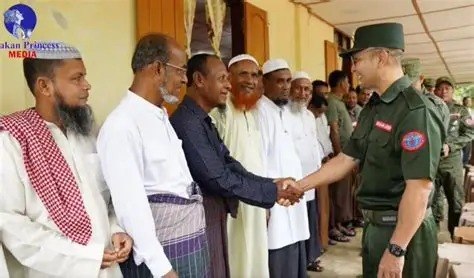
Across areas under ULA administration, Muslims are increasingly involved in local governance, public administration, law enforcement, community affairs, and even security structures. Religious activities that were previously restricted in some areas have gradually resumed, while everyday interactions between Rakhine and Muslim communities appear to be changing.
These developments should not be interpreted as evidence that all challenges have disappeared. Questions regarding equality, accountability, rights protection, and long-term political inclusion remain unresolved.
However, they highlight a critical question for policymakers and international observers: is the global understanding of Arakan keeping pace with the realities emerging under a new political order?
A New Governance System and Muslim Participation
One of the clearest indicators of change is the growing participation of Muslims in emerging governance structures.
In recent months, the AA has publicly shared images of Muslim members participating in community activities, including Muslim women soldiers involved in flood-relief operations in northern Arakan. The organization has also released images showing Muslim men serving within its armed forces.
The exact number of Muslims participating in the AA remains difficult to verify independently. Nevertheless, their presence within a security structure historically dominated by exclusion represents a significant development.
Beyond security affairs, Muslim involvement in administration has also become increasingly visible. Local reports have suggested that thousands of Muslims are now working in administrative, judicial, and law enforcement roles in areas under ULA control. While precise figures require further verification, the broader trend reflects a practical reality: governing Arakan requires the participation of all communities living there.
This is not merely symbolic inclusion. It is a necessity of effective governance.
Local authorities require officials who understand community dynamics. Courts need personnel familiar with local contexts. Public services cannot function effectively without cooperation from the populations they serve.
The key challenge ahead is whether Muslim participation will remain limited to administrative roles or evolve into meaningful political representation, decision-making, and institutional accountability.
Religious Life and the Expansion of Social Space
Another important indicator of Arakan’s changing landscape is the evolving space for Muslim religious life.
For many years, Muslim religious activities in parts of Arakan were shaped by restrictions, administrative barriers, and limited institutional space. Recent developments suggest that this environment is gradually changing in some areas.
In recent years, some Muslim religious institutions that had been closed or restricted have reportedly reopened. The ULA has also engaged publicly with Muslim religious leaders and participated in community activities.
These developments matter because religious freedom is experienced not only through formal policies but also through daily life: whether communities can maintain places of worship, observe religious practices, and preserve their identity without fear.
The emerging relationship between the ULA and Muslim communities represents a notable shift from previous governance approaches that often emphasized control rather than engagement.
The important question is whether this expanding social space can become a foundation for broader inclusion.
Freedom of Movement and Rebuilding Social Connections
Freedom of movement represents another important indicator of social transformation in Arakan.
For years, restrictions on Muslim mobility in parts of Arakan affected access to education, healthcare, employment opportunities, markets, and family networks. These limitations created not only economic difficulties but also contributed to deeper social separation between Muslim and Rakhine communities.
However, this aspect of daily life appears to be changing in areas under ULA administration. Reports from within these areas indicate that Muslims in some locations now have greater ability to travel for essential activities, including accessing markets, seeking medical treatment, pursuing employment opportunities, and maintaining social connections with wider communities.
The expansion of mobility represents a significant shift from previous conditions, where movement restrictions often limited economic participation and reinforced community isolation. Greater freedom to travel allows individuals and families to reconnect with social networks, participate more actively in local economies, and access essential services beyond their immediate communities.
Nevertheless, these developments should be viewed within the broader context of ongoing conflict and administrative transition. Freedom of movement is not uniform across all areas, and security concerns, local conditions, and governance arrangements continue to influence people’s daily experiences.
Despite these limitations, increased mobility can play an important role in rebuilding social and economic relationships.
Understanding Arakan Beyond a Single Narrative
These developments present a challenge for international policymakers, particularly Bangladesh, which continues to host a large refugee population and has legitimate concerns regarding safe, voluntary, and dignified return.
However, refugees living outside Arakan and Muslims remaining inside Arakan represent different realities.
Refugees face displacement, humanitarian dependency, and uncertainty about their future. Those inside Arakan are navigating a changing political environment in which their relationship with authorities and neighboring communities is being reshaped.
A sustainable solution requires understanding both realities.
These questions provide a more accurate understanding of whether Arakan’s transformation is leading toward genuine inclusion.
The untold story of Arakan is therefore not simply about whether Muslim communities are returning, remaining, or rebuilding.
It is about whether they are becoming participants in shaping what Arakan will become under its new political order.
Understanding Arakan Beyond a Single Narrative
These developments present an important challenge for international policymakers, particularly Bangladesh, which continues to host a large refugee population and has legitimate concerns regarding safe, voluntary, and dignified return.
However, the realities of refugees living outside Arakan and Muslim communities remaining inside Arakan are not identical. Refugees continue to face displacement, humanitarian dependency, and uncertainty about their future. Meanwhile, those who remain inside Arakan are navigating a changing political environment in which their relationship with authorities, institutions, and neighboring communities is being reshaped.
A sustainable solution requires understanding both realities simultaneously. The future of Arakan cannot be assessed only through the lens of displacement or repatriation; it must also consider the evolving conditions of governance, participation, social relations, and inclusion within the region itself.
Examining who can participate in local administration, access public services, practice religious beliefs, move freely, and contribute to decision-making provides a more complete understanding of whether Arakan’s transformation is moving toward genuine inclusion.
The untold story of Arakan is therefore not simply about whether Muslim communities are returning, remaining, or rebuilding. It is about whether they are becoming meaningful participants in shaping the political, social, and economic future of a region undergoing historic change.